Snowmaking on the slope by the Saxner chairlift in Černý Důl, Giant Mountains, 29 December 2019

Hotel KapitánData analysisSki season 2026/27

A day's skiing in Czechia costs 62% more than before covid. Natural snow is down 42⁠–⁠50%

Archived price lists from nine ski areas, inflation and wages from the Czech Statistical Office, and 66 winters of daily snow measurements from the Czech Hydrometeorological Institute. Skiing has outpaced wages, and the season now runs on machine-made snow.

Photo: JiriMatejicekCC BY-SA 3.0Wikimedia Commons

Walk-up ski pass since 2019/20
+62%

nine ski areas, adult, 1 day, main season

Average wage over the same period
+46%

consumer prices +46%

Days with 30 cm of natural snow
−42 to −50%

1961–1990 against 2011–2026, above and below 1,000 m

Ticket office vs online, Špindl 13 Feb
2.2×

CZK 1,990 against CZK 910

Skiing in the Czech Republic gets more expensive every winter, but by how much? We went through the ski areas' archived price lists back to the 2016/17 season, compared them with inflation and wages from the Czech Statistical Office, and counted how many days each winter natural snow lies at the mountain stations of the Czech Hydrometeorological Institute. Two things stand out. A day on the slopes costs more than inflation and wages would explain. And the snow skiers pay for comes more and more often out of a snow gun.

Ski passes outpaced wages

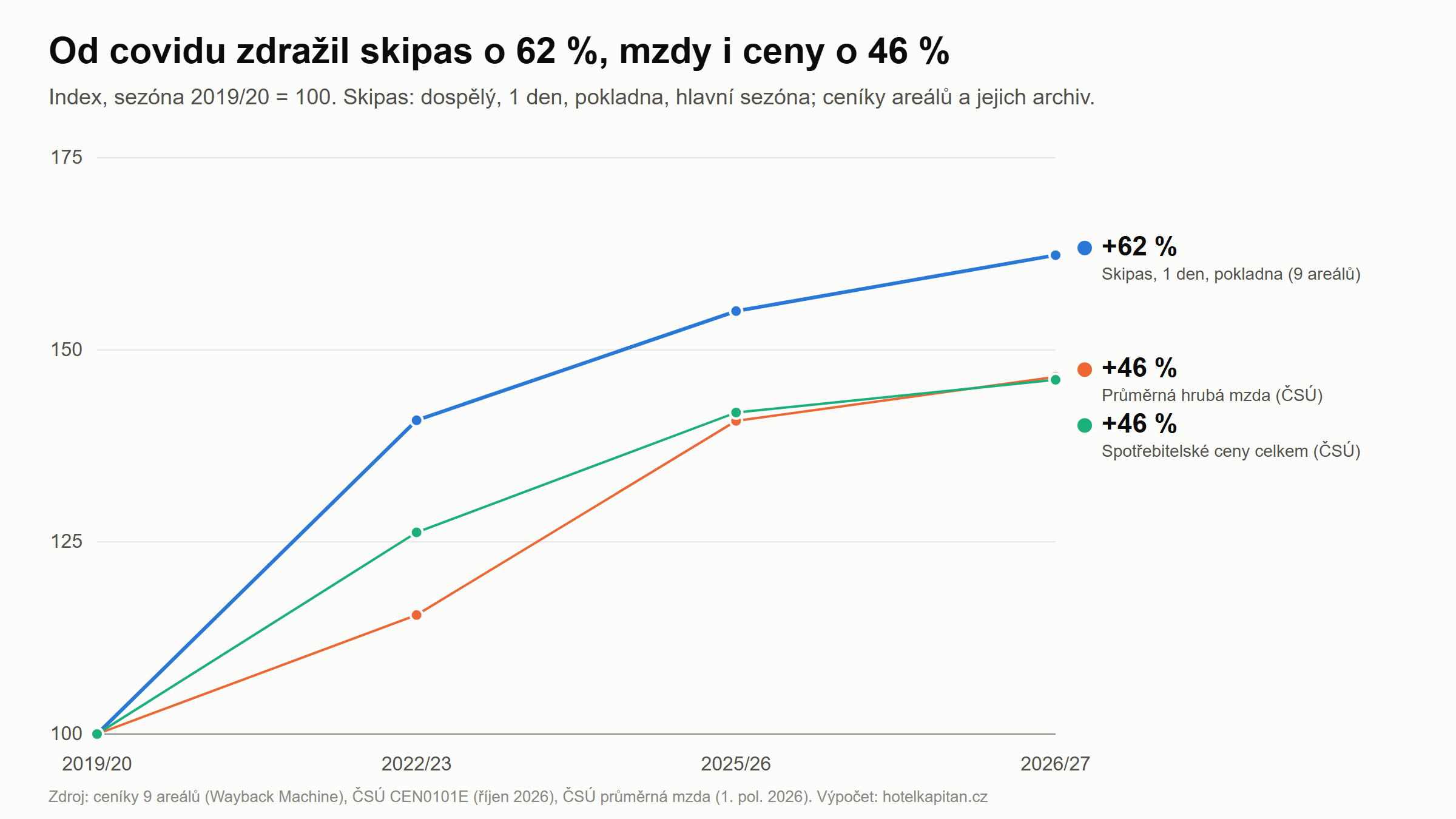
At the nine ski areas whose price lists survive for all five seasons we looked at, an adult one-day pass bought at the ticket office in main season cost CZK 6,050 in total in 2019/20. This winter the same nine days of skiing cost CZK 9,820, 62% more. Over the same period the average gross wage rose 46% and consumer prices 46%.

Most of the rise came at once. Between 2019/20 and 2022/23, the years of covid and the energy crisis, ski pass prices rose 41%, while inflation was 26% and wages grew 15%. Since then passes have risen roughly in line with other prices, but they never came back down.

Since covid, ski passes rose 62%; wages and prices 46%

Index, first season = 100. Ski pass: total for the nine ski areas with price lists from all five seasons.

1001251501752019/202022/232025/262026/27+62%Walk-up ski pass+46%Average wage+46%Consumer prices (inflation)
Source: ski area price lists and their archives; ČSÚ (CEN0101E, average wage). Wage for 2026/27 = first half of 2026.

The Czech Mountain Resorts Association (AHS ČR) says that this season a quarter of ski areas kept their prices and the rest raised them by 2 to 3% on average, roughly in line with inflation. For this year that holds. Over ten years, though, the ski pass rose 84%, while prices overall rose 57%.

Resort by resort

The big resorts rose the most. In Špindlerův Mlýn a one-day pass at the ticket office cost CZK 890 in main season 2016/17; this winter it costs CZK 1,990. Had it risen only with inflation, it would cost CZK 1,402. Of the eleven ski areas with prices for both 2016/17 and 2026/27, only Šumavský Špičák stayed below inflation.

Eleven ski areas: what a day pass cost then and now

Hollow circle = 2016/17, filled = 2026/27. The vertical tick shows what the pass would cost had it risen only with inflation.

  • 2016/17
  • 2026/27
  • price had it risen only with inflation
05001,0001,5002,000Špindlerův Mlýn+124%Tanvaldský Špičák+118%SkiResort Černá hora – Pec+112%Monínec+98%Ještěd+95%Karlov+80%Herlíkovice+68%Obří sud Javorník+67%Zadov – Churáňov+67%Kouty+62%Šumavský Špičák+56%
Source: ski area price lists (Wayback Machine), ČSÚ. Adult, 1 day, ticket office, main season. Hour of work = average gross wage / 173.8 h.

Measured against wages, the picture is more mixed. At smaller ski areas such as Kouty, Zadov or Herlíkovice, a day's skiing now takes fewer hours of work than ten years ago. In Špindlerův Mlýn it takes 6.8 hours instead of 5.6.

More ski areas with incomplete price series
Ski area2016/172019/202022/232025/262026/27
Klínovec–8501,0901,1901,250
Deštné v Orlických horách––––940
Ramzová–650750900900
Přemyslov–500650720720
Novako Jáchymov––490–580
Lipno (2026/27: online shop's standard price)7108601,290–1,540

Dolní Morava, Rokytnice nad Jizerou, Pancíř and Telnice have not yet published their 2026/27 prices.

Up to twice the price at the ticket office

Fewer and fewer skiers pay the ticket-office price, though. The big resorts sell most passes online, at prices that change with the day and with demand. According to the Czech news site iDNES, Špindlerův Mlýn takes about 80% of its ski pass revenue online and at self-service kiosks.

Špindlerův Mlýn: online the price changes every day; at the ticket office it is always CZK 1,990

Adult one-day pass, 2026/27 season. Each square is one day; the darker, the more expensive online. The ticket-office price is the same on all 122 days.

December
January
February
March
April

Hover over or tap a day. Weekends have a darker edge.

Source: price calendar on skiareal.cz, retrieved 26 November 2026. Online prices can change with demand.

Online, a day in Špindlerův Mlýn costs CZK 860 to 1,520, and CZK 490 from 8 March. At the ticket office it costs CZK 1,990, every day. The most expensive days online fall between Christmas and New Year's Eve. Anyone who buys a pass on the spot pays more than double on some days. It is similar at Ještěd and Monínec.

Ticket office against the online shop

Vertical line = ticket-office price. Bar = range of online prices on selected days of the 2026/27 season.

  • online (range)
  • ticket office
  1. Špindlerův Mlýn490–1,520 online · 1,990 ticket office
  2. Ještěd380–640 online · 1,150 ticket office
  3. Monínec360–720 online · 1,090 ticket office
  4. Zadov – Churáňov350–812 online · 900 ticket office
  5. Rokytnice nad Jizerou240–1,010 online · 0 ticket office
  6. Lipno (online shop's standard price)690–840 online · 1,540 ticket office
Source: ski area price lists and online shops as of 26 Nov 2026 (online prices for 27 Dec, 13 Jan, 13 Feb and the lowest offered).
Snow guns on a bare brown slope in Boží Dar, 22 November 2020

Without snowmaking, most Czech ski areas could not open on time. According to the resorts' association, about two thirds of their investment goes into machine-made snow.

Photo: HorakvladoCC BY-SA 4.0Wikimedia Commons

Half the natural snow

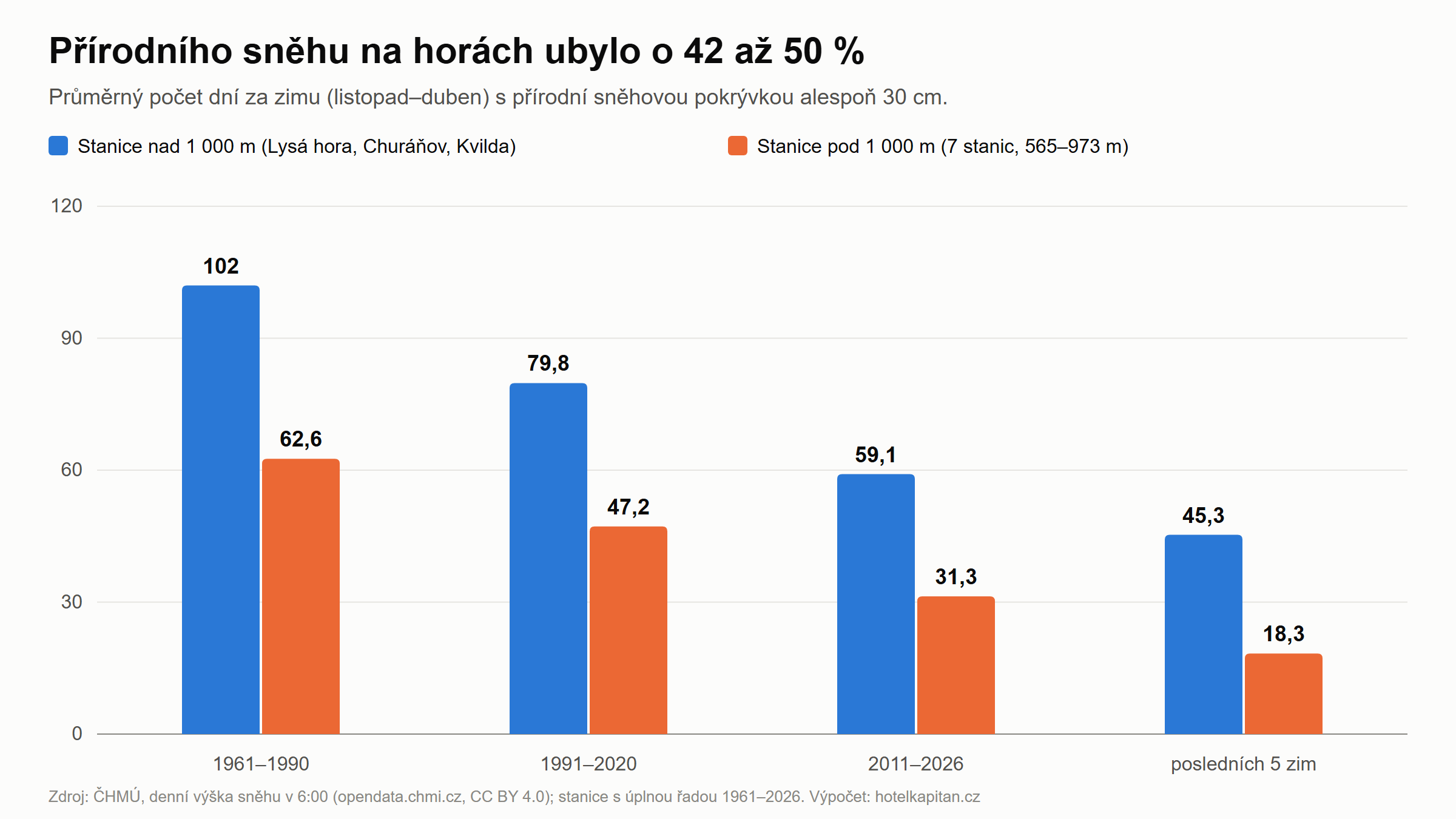
The other half of the story is snow. ČHMÚ publishes daily snow-depth measurements from its stations. We picked eleven mountain and upland stations with long records and counted how many days each winter (November to April) had at least 30 centimetres of natural snow on the ground: roughly what you need to ski without snowmaking.

Days with at least 30 cm of natural snow

Average per winter (November–April). Stations with a complete record since 1961.

  • Stations above 1,000 m
  • Stations below 1,000 m
03060901201961–199010262.61991–202079.847.22011–202659.131.3last 5 winters45.318.3
Source: ČHMÚ, daily snow depth at 06:00 (CC BY 4.0). Above 1,000 m: Lysá hora, Churáňov, Kvilda. Below 1,000 m: Špičák, Milešovka, Bedřichov, Desná-Souš, Ramzová, Svratouch, Horní Bečva.

At stations above 1,000 metres (Lysá hora, Churáňov, Kvilda), that much snow lay on 102 days a winter on average in 1961–1990, 59 days in 2011–2026 and 45 days in the last five winters. Below 1,000 metres the count fell from 63 to 31 days, and to 18 in the last five winters. About 7 to 8 such days are lost every decade.

December to February is 1.7 to 2.1 °C warmer at these stations than in 1961–1990. Frosty days in November and December, when ski areas can make snow, have become rarer too: days with a minimum of −4 °C or lower are down 28 to 42%.

Station by station

Every winter at eleven mountain stations

Each bar = the number of days in one winter with at least 30 cm of natural snow (same 0–180 day scale for every station). Brown lines: averages for 1961–1990 and 2011–2026. Darker bars = winters since 2011.

Lysá hora

Beskids · 1,322 m

−20%
196119912026


Labská bouda

Giant Mountains · 1,320 m

since 1980
196119912026


Churáňov

Bohemian Forest · 1,118 m

−59%
196119912026


Kvilda

Bohemian Forest · 1,059 m

−57%
196119912026


Špičák

Bohemian Forest · 973 m

−45%
196119912026


Milešovka

Central Bohemian Uplands · 831 m

−81%
196119912026


Bedřichov

Jizera Mountains · 777 m

−42%
196119912026


Desná-Souš

Jizera Mountains · 772 m

−36%
196119912026


Ramzová

Jeseníky · 740 m

−48%
196119912026


Svratouch

Žďár Hills · 734 m

−73%
196119912026


Horní Bečva

Beskids · 565 m

−75%
196119912026


Source: ČHMÚ (CC BY 4.0). Labská bouda has a comparable record only from 1980 (a different site measured before). Missing bars = winters with incomplete data.

Places that had less snow to begin with lost the most. Milešovka lost 81% of its days with 30 centimetres of natural snow, with none at all in the last five winters. Svratouch in the Žďár Hills, the nearest mountain station to Seč Reservoir, lost 73%. Churáňov in the Bohemian Forest had no such day in the winters of 2014, 2015, 2020 or 2025. The highest stations hold up best: Lysá hora lost 20%, and Labská bouda shows no measurable trend since 1980.

The Svatá Anna ski slope in Chotěboř without snow, 27 February 2022
The Svatá Anna ski slope in Chotěboř without snow, 27 February 2022. Chotěboř is less than 15 kilometres south of Seč Reservoir.

Photo: ŠJůCC BY 4.0Wikimedia Commons

A 30-centimetre base also arrives later. At Churáňov, half of the winters had one by 4 December in 1961–1990, but only by 31 December in 2011–2026. In Bedřichov the date moved from 1 December to 4 January.

Last winter ran on machine-made snow

The resorts' association called the 2025/26 winter a success: visitor numbers were 5% higher than the year before and the average season lasted 100 days. Yet there was very little natural snow.

Winter 2025/26 against the normal

Days with at least 30 cm of natural snow: light bar = 1991–2020 average, dark bar = last winter.

  1. Milešovka831 m0 of 10 (0%)
  2. Svratouch734 m0 of 20 (0%)
  3. Horní Bečva565 m3 of 28 (11%)
  4. Kvilda1,059 m8 of 66 (12%)
  5. Bedřichov777 m9 of 71 (13%)
  6. Ramzová740 m6 of 40 (15%)
  7. Churáňov1,118 m11 of 55 (20%)
  8. Desná-Souš772 m22 of 83 (27%)
  9. Špičák973 m39 of 79 (50%)
  10. Lysá hora1,322 m81 of 119 (68%)
  11. Labská bouda1,320 m113 of 143 (79%)
Source: ČHMÚ (CC BY 4.0). January–April 2026 data are provisional.

At Churáňov, 30 centimetres lay on 11 days, against an average of 55 in 1991–2020. In Bedřichov it was 9 days instead of 71; at Svratouch and Milešovka, not one. The season ran on machine-made snow. According to the association, snowmaking accounts for more than half of most resorts' electricity use.

Labská bouda in the Giant Mountains, February 2021

The Giant Mountains ridges have had a strong start this year: on 25 November there were 46 centimetres of snow at Labská bouda.

Photo: Tadeáš GregorCC BY-SA 4.0Wikimedia Commons

How this winter is starting

This winter is starting above average on the highest mountains. On 25 November there were 46 centimetres of snow at Labská bouda; only in 4 of the 24 years with data since 1996 was there as much or more on that date. Lower down, snow is still missing: Churáňov had 2 centimetres, Svratouch and Milešovka none.

Snow at the stations on 25 November 2026

Total snow depth at 06:00, and how many years since 1996 had as much or more on this date.

  1. Labská bouda1,320 m46 cmas much or more in 4 of 24 years
  2. Lysá hora1,322 m16 cmas much or more in 11 of 30 years
  3. Desná-Souš772 m14 cmas much or more in 8 of 30 years
  4. Bedřichov777 m6 cmas much or more in 11 of 30 years
  5. Horní Bečva565 m5 cmas much or more in 9 of 30 years
  6. Ramzová740 m3 cmas much or more in 10 of 30 years
  7. Churáňov1,118 m2 cmas much or more in 17 of 30 years
  8. Milešovka831 m0 cmno snow
  9. Svratouch734 m0 cmno snow
Source: ČHMÚ, provisional data (may still be corrected). Ramzová: last value from 23 Nov.

ČHMÚ's monthly outlook for 23 November to 20 December expects well below-average temperatures until about 6 December, good for snowmaking. After that it should warm to normal, with rain prevailing at lower altitudes.

15 Nov
Monínec already open; about 40% of its snow was stored under insulation from last winter
28 Nov
Černá hora
30 Nov
Šerlišský Mlýn
4 Dec
Špindlerův Mlýn, Pec pod Sněžkou, Lipno, Říčky
5 Dec
Malá Úpa
12 Dec
Ještěd, Dolní Morava, Bílá depending on snow

Dates from the ski areas, ČTK and the resorts' association as of 26 November 2026. They may change with the weather.

What it means for skiers

  1. Buy online and in advance. At the big resorts you save a quarter to three quarters of the ticket-office price. In Špindlerův Mlýn online prices are lowest in early December (from CZK 860) and from 8 March (CZK 490).
  2. Avoid the holidays. The most expensive days online in Špindlerův Mlýn fall between Christmas and New Year's Eve (CZK 1,520).
  3. Higher means safer. Above 1,000 metres natural snow lasts about twice as long as lower down (59 against 31 days a winter in 2011–2026).
  4. Check the snow before you go. We publish the daily snow depth from ČHMÚ stations for 60 ski areas in our overview of Czech ski areas (in Czech).

How we calculated

Prices. We compare an adult one-day pass bought at the ticket office in main (or the highest regular) season, as given in the ski area's own price list. Current price lists were downloaded on 26 November 2026, older ones from the Wayback Machine (snapshots taken during that winter). The index is the total for the nine ski areas with price lists from all five seasons; across all eleven ski areas the rise since 2016/17 is +88%.

Inflation and wages. ČSÚ consumer price index (CEN0101E, 2025 = 100): the 2019/20 season = December 2019, the 2026/27 season = October 2026. ČSÚ average gross monthly wage: the 2019/20 season = the year 2019, 2026/27 = the first half of 2026 (CZK 50,650). Hour of work = wage / 173.8 hours.

Snow. Daily total snow depth at 06:00 from ČHMÚ open data (CC BY 4.0), winters 1961–2026. We use stations with a complete record that did not move by more than 50 metres in altitude, and leave out values flagged as unreliable or affected by machine-made snow.

Limitations
  • The ticket-office price is not what most skiers pay. It shows how the list price has moved, not the average price paid.
  • Nine (or eleven) ski areas are not a random sample; they are the most searched-for ski areas whose comparable price lists survive.
  • Some ski areas changed their age bands or what the pass covers (Monínec, Karlov, SkiResort). Without them the rise since 2016/17 comes out almost the same.
  • 30 cm as a skiable base and −4 °C as a snowmaking condition are simplifications. A weather station is not a ski slope.
  • ČHMÚ data for January–April 2026 and November 2026 are provisional and may still change.

Data downloads

You may reuse the data freely with the credit “analysis by Hotel Kapitán of ČHMÚ, ČSÚ and ski area price list data”.

Sources

Hotel Kapitán on the shore of Seč Reservoir

Who is behind this analysis

Hotel Kapitán is a family-run hotel on the shore of Seč Reservoir in the Iron Mountains. In winter we host schools, sports clubs and groups, and on our website we publish guides to the area with data you can check.

Group stays
Book your stay